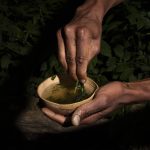
How shall we greet the sun is a powerful testimony in pictures and texts by Thana Faroq. The book testifies of her personal involvement with the experiences of a group of women: Thana’s peers, who migrated from their countries of origin – Yemen, Syria, Afghanistan, Eritrea, Iraq, and Palestine – to The Netherlands. Thana follows them in the process of ‘emerging from the ashes’ and finding a new future. The women are portrayed while getting connected to their Dutch environment. Their emotions show: being weary, thoughtful, and searching for energy at the same time.
Photographer Thana Faroq spoke about her photobook at the FOTODOK Book Talks at TivoliVredenburg, Utrecht on December 7th. Peter Romijn, historian and editor for FOTODOK, followed up the conversation with Thana to speak about creating a memory archive of emotions.
HALF OF THE STORY
Thana, your book shows a broad range of emotions in the women portrayed. The pictures and texts are woven together and create one whole image of all lived experiences. The book is a poetic narrative of images and words. Was it your intention that they cannot be separated into individual photographs or texts?
When I write, I don’t even call it writing, the words are also images, of a different sort. I verbalize by means of pictures and I create images in words. If you see one picture alone, you will only get half of the story, but together they give you the whole story. In this respect, photography is going through changes, at least my kind of photography.
Does this collection narrate a story in its entirety? The images don’t have captions, should I even expect concise, informative captions?
I deliberately moved away from a journalistic style. The intention is not to provide specific names and locations, nor to answer typical questions like “What happened to these women?”. This book isn’t about the start or the end of their stories. It focuses on the middle phase – the period of uncertainty and change. It captures the transitional limbo they are experiencing, highlighting the significant developments in their lives and the formation of their new identities. The book aims to portray the journey they are undergoing, emphasising their emotions and resilience throughout this transformative period.

Rebirth. Photo was taken in the Hague, The Netherlands. (c) Thana Faroq
NEW NARRATIVES AND NOSTALGIA
Your book testifies of individual emotions, at the same time it concerns universal experiences. It reminds me of an article by philosopher Hannah Arendt entitled ‘We Refugees’, she wrote it in 1943, after her escape from Nazi-controlled France to the United States: ‘The less free we are to decide who we are, or how we want to live, the more we will try to build a façade, to conceal the facts and to assume roles.’ Do you recognise this in your work, is this a situation you would wish to escape?
My work is not about escaping past events and memories of the past. I am still living in those memories. Moving to another place does not erase memories. My aim as an artist is to create space for a new narrative. That should help us to discuss present feelings and create space for shaping a future. For the sake of that discussion, I want to create a living image of feelings, of emotions, of certain incidents.
It’s not my aim to make people uncomfortable about what’s wrong in the world, I want to bring these experiences closer, taken from the heart. Creating a new narrative allows for engagement and should help us to shape a future. That is not ‘escaping’.
What bothers me most is being nostalgic about a place that does not exist anymore. It only exists in our memories. Longing for that past creates a barrier for us to engage with each other and face our problems of today. You cannot relate to my past, my past thoughts and experiences, but you will relate very much to the person who I am today. Nostalgia can hold us back from creating new memories that matter. For me, resilience and nostalgia go against each other, and that’s what I hate about it. The more nostalgic you get, the less resilient you will be.
BEYOND JOURNALISM
When making this photo book, did you start from a preconceived idea, or did it grow step by step?
My first book (I don’t recognize me in the shadows, 2020, on life in a Dutch center for asylum seekers) was envisaged more in a journalistic mode. I had started out as a documentary photographer in my native Yemen, taking commissions from NGO’s, being respected for my documentary work. And then, I happened to be here, I took up the subject of transition via the center and decided to grow with that. Having done that, I felt the time had now come for a different approach. For this project I did not want to work outside of the group but bring in my own experience while relating to what we are all going through.
And why not approach this as a journalist? Would this require an outsider position and put you out of focus?
I felt uncomfortable about the idea that the first book would suggest something like “hey, you guys have made it, and this is your happy ending”. There is no end to their story, there is so much left to tell. People focus on the one big outcome and tend to forget about what happens in the middle. It’s the process that people are going through, physically and mentally, that continues and requires attention. I intend to create space for that process to happen. That should also help us understand trauma. All things considered, I made this book for myself in the first place, and through myself, for my son. So I can explain to him what happened, when he’s growing up.
Being in the center of the group and mutually sharing your experiences, did you also build on your experience as a documentary photographer?
I took documentary photography up as a profession, it gave me lots of confidence, because it was not easy to be a street photographer in Sanaa, not as young as I was, as a woman. I always had to find a companion to cover me. Photography was never easy, also because of the political situation. I always needed to cover the camera; many saw it as a frightful machine. Holding the camera now, it’s an act of empowerment.
Here in The Netherlands, it simply feels amazing, everybody is taking pictures here, nobody finds it a big thing. At the same time, there is lots of respect for the art and the artist. The camera gives me an identity, I don’t have to explain anything, just say ‘I’m a photographer’, and that’s it. It gave me the space.

Kimiya Left her home Iran 4 years ago, currently a refugee in the Netherlands. Photo was taken in the Hague, The Netherlands. (c) Thana Faroq
CONNECTING THROUGH THE IMAGE
What struck me in the book are the very Dutch surroundings in which the women are moving. We see skinny trees, the sea, and the typical urban landscapes. Does it suggest the women are going through a process of getting accustomed to their new environment?
Well, I am getting familiar with the landscape, I can see that the Dutch love it and so do I. Here we are having four seasons, the climate expresses the moving of life and that certainly lifts me up. In Yemen we don’t have it like that. At the same time, the landscape implies connections, in particular the sea can be seen as a bridge between the different experiences.
Your present work embodies emotions. I see you are playing with shutter-time, focus, and color. Do you do this towards a result, or is this a matter you conclude afterwards on?
My photography is a way of connecting, I will make sure to reflect on what I see, to internalize it and let the pictures make me see better and connect to the subject. My photography is very much about self-searching. At the same time, it shows others how they can search and come up with more general ideas about the state of the world. For that reason, I felt the urge to work on this book, which I call ‘Chapter 2’ after the first book, ‘Chapter 1’.
In a small letter in the small envelope attached to the back of the book you write about the elusive character of estrangement. You compare the job of showing this estrangement to trying to catch a ‘slippery fish’. Will there be a ‘Chapter 3’ where you look for the answers?
Actually, I’m moving on with something else. I am relating to the massiveness of the digital archives that I have, especially about the people who are still stranded. These pictures are in my archive for years, and in a way these images can be brought back in view. But what about my memories? I do not remember the stories of these people, I don’t remember their names. So I’ve started to come up with fictional texts as a response. I must see what will happen in this project, I’m still experimenting and trying to find out.
After our conversation we decided to visit ‘Pioniers – Fotografie door vrouwen’ together. This exhibition was put together from the Dutch National Archives’ own world-renowned collection, and is an overview of the accomplishments of female photographers over more than a century. The contrast of these fascinating ‘classical’ pictures and ‘How shall we greet the sun’ jumps to mind. Thana’s book brings in a multi-layered, stylistically refreshing approach. The book offers food for thought and consideration about matters of empathy, change, and identity: an archive of emotions indeed.
You can buy the book How shall we greet the sun through the publisher via this link.
Peter Romijn
December 12, 2023.